
Who they are
The Fulfillment Lab is a technology-enabled 3PL serving growing e-commerce brands and enterprise clients from two facilities: Tampa, Florida and Salt Lake City, Utah. Clients rely on them for inventory management, order fulfillment, shipping, and returns, with the responsiveness of a boutique partner at enterprise volume.
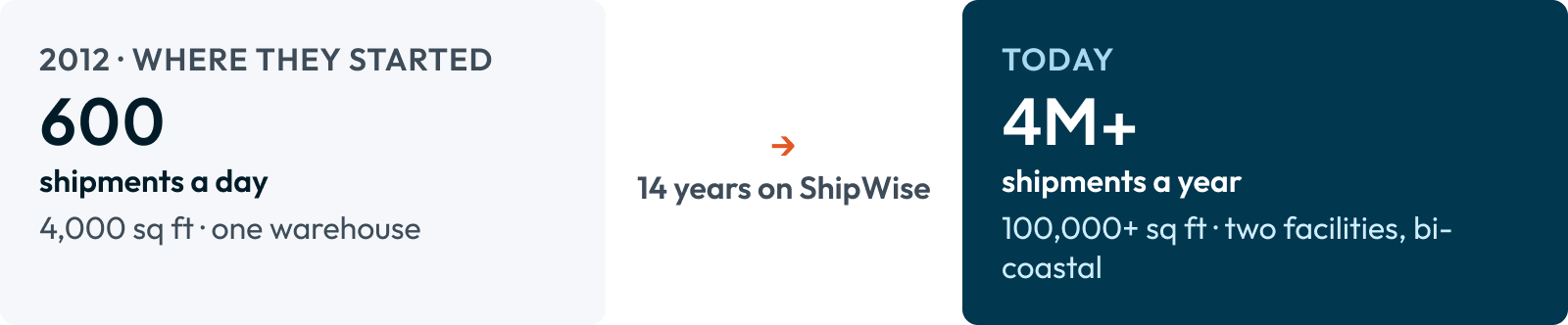
Founder and CEO Rick Nelson started the company in 2012, doing five or six hundred shipments a day out of a 4,000 square foot warehouse. Today the operation runs over 100,000 square feet of facilities and upwards of 4 million shipments a year.
The promise: in by noon, out the same day
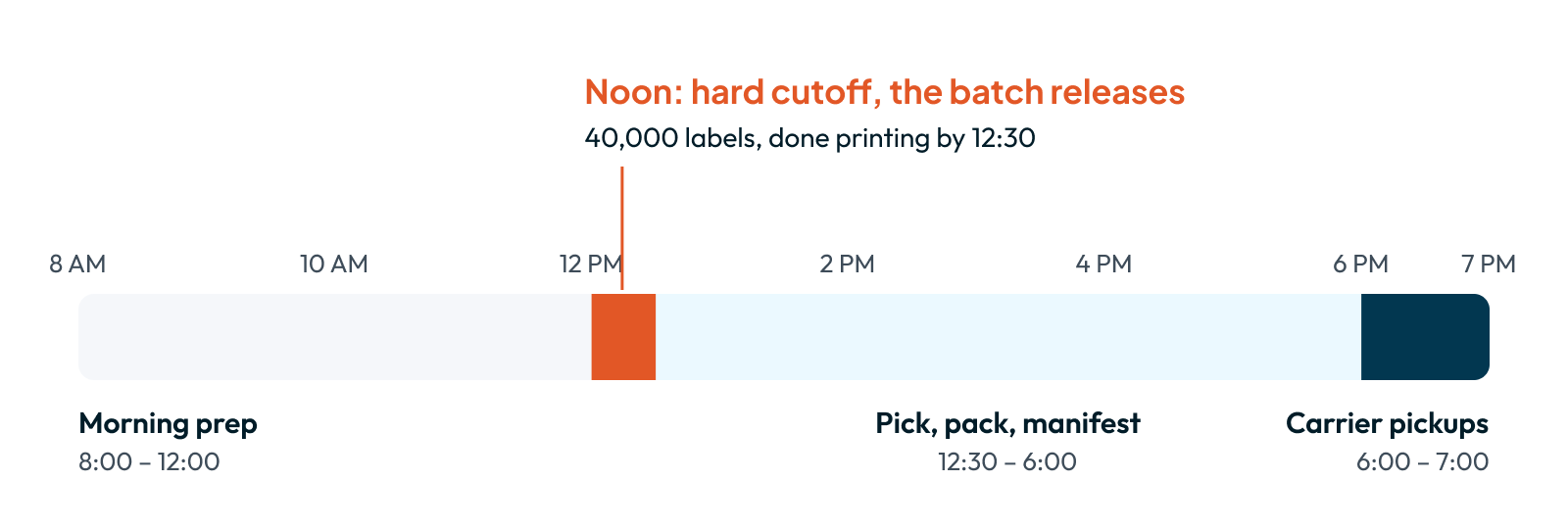
Orders received before noon Eastern ship the same business day. That is the standard promise, and the operation is built backward from it. Mornings are prep: inventory staged, orders queued, the floor set. At noon, everything that came in releases at once.
"If we ask the operation what their job is: number one, all orders get out same day. If we don't do that, what are we here to do?"
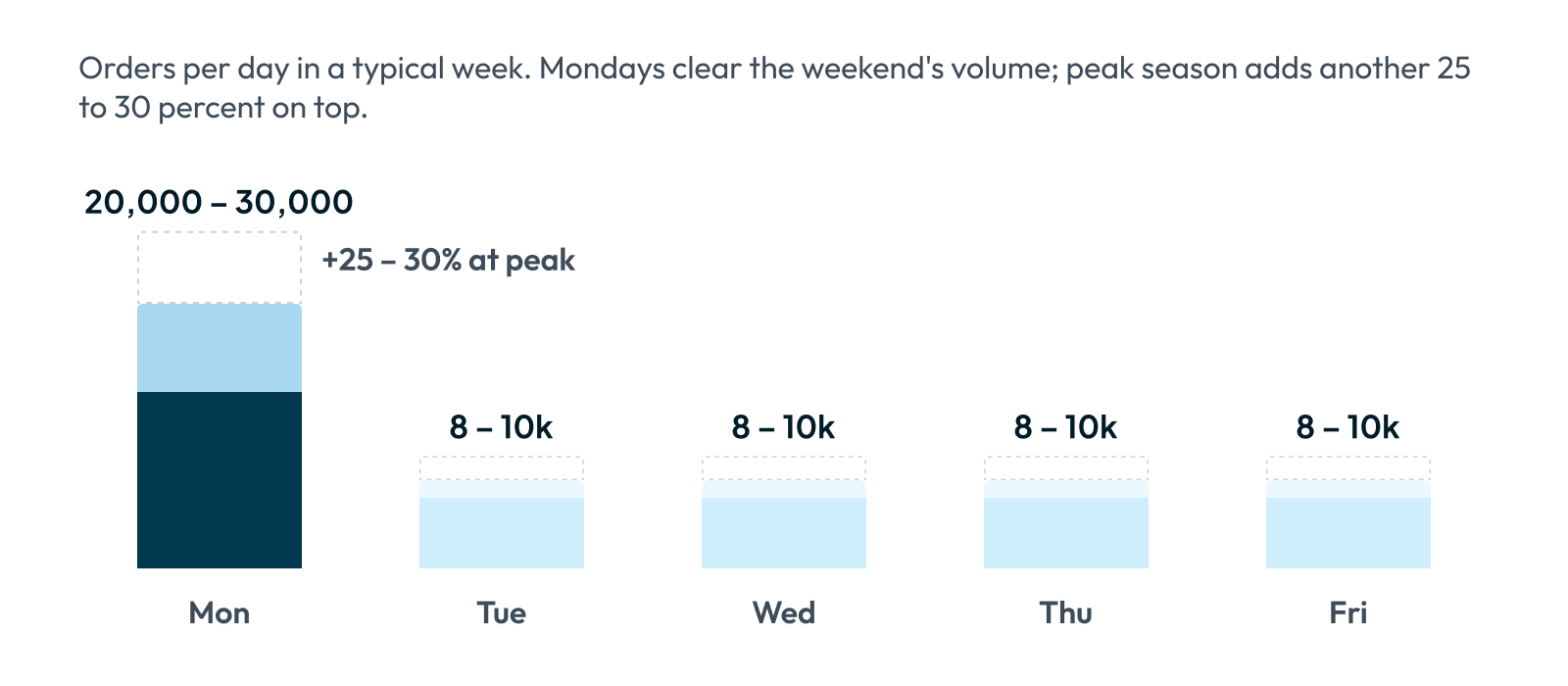
The volume behind that promise: 8,000 to 10,000 orders a day Tuesday through Friday, and 20,000 to 30,000 on Mondays when the weekend's volume clears. Peak season adds another 25 to 30 percent on top. Salt Lake City handles roughly 40 percent of total volume, Tampa the other 60, and both facilities run as one connected network. On the heaviest days, the operation moves up to 40,000 shipments, with as much as half of that hitting the system the moment the noon cutoff closes.
What one label can break
At this scale, seconds become hours. A few seconds lost per order, repeated across tens of thousands of orders, turns into labor overruns, missed carrier pickups, and late shipments. Carriers collect between 6:00 and 7:00 pm. There is no slack between the noon start and that cutoff.
And the cost of a miss lands beyond the warehouse. TikTok, Amazon, and Walmart all track fulfillment performance on TFL's clients. A late package damages the client's marketplace standing, the marketplace's promise to its buyer, and TFL's reputation as the operator in the middle.
"Every label is mission critical." If one label can't print because of a technology issue, and no answer comes before the 6:00 cutoff, the client's promise to the consumer is already broken.
Why ShipWise
Nelson vetted six or seven shipping platforms before choosing. What TFL needed was more than label printing: carrier connectivity, routing flexibility, batch processing, and an API-driven platform that could become part of its own technology stack.
Speed settled it. At eight seconds per label, 40,000 labels is an impossible day. ShipWise processed in milliseconds. "The bottleneck was how fast can a Zebra printer print. It wasn't what ShipWise could do."
Fourteen years later, the bar has stayed where it was set. "We own all of our tech. We like to control it. We have done that in every aspect of our business, except in this aspect. We can't do it better."
Inside the stack
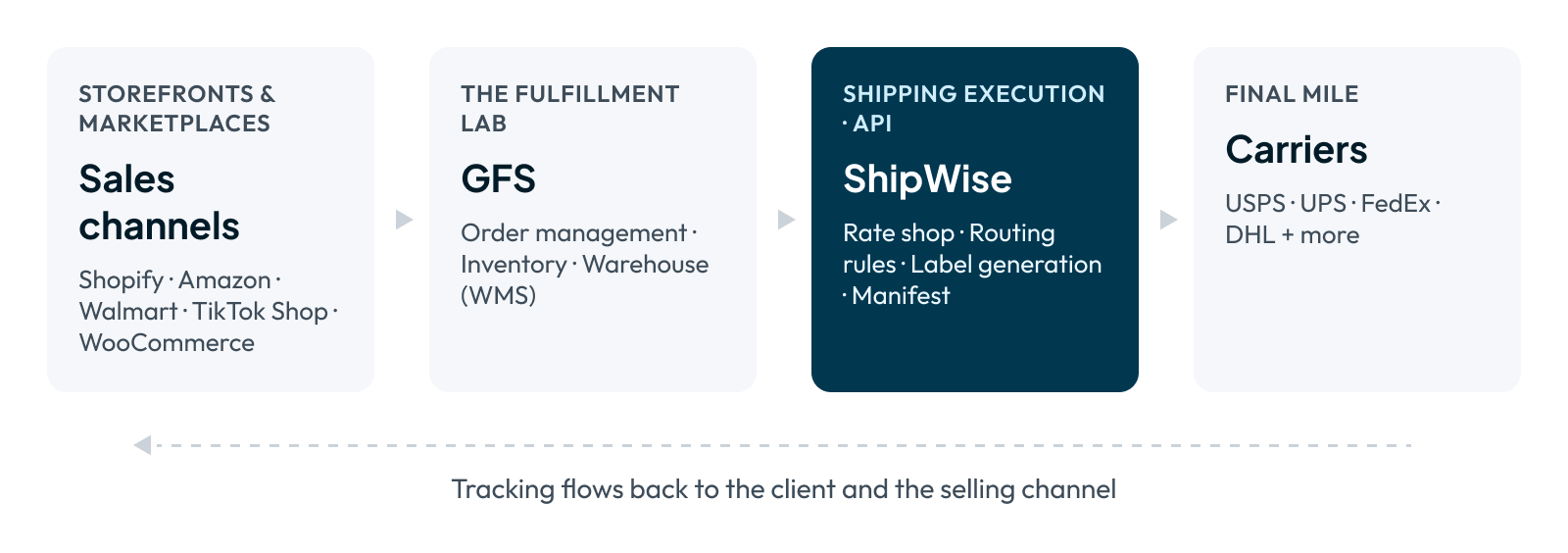
An order enters through a client integration such as Shopify, Amazon, Walmart, TikTok Shop, or WooCommerce and flows into TFL's Global Fulfillment System, which validates the order, allocates inventory, and releases it to the right facility. The warehouse picks and packs. At the shipping stage, TFL's platform calls ShipWise through the API: service and routing rules apply, the label and shipment data generate, and tracking flows back to the client and the selling channel.
"ShipWise is the shipping execution layer. During peak hours, the goal is for the interaction to be almost invisible to the user: scan, process, label, and move."
Routing logic lives in configurable rules, not in a packer's head. Carrier pricing, service performance, delivery regions, and client requirements change constantly; TFL's team adjusts the rules, and no one makes carrier decisions order by order at the pack station. Each facility keeps its own carrier pickups, zones, and client mix under one consistent stack. And when carriers change their systems, that work never reaches TFL: "Carriers are always making changes. They're always changing their API. There's always something. We don't have to do any of that." TFL's developers stay on client-facing work instead of carrier maintenance.
The results
In 14 years, shipping execution has never been the bottleneck. "We've never had a delay because we're waiting on something from ShipWise."
The proof case is peak season: one facility batch-prints 40,000 labels. "We send that batch at noon, and at 12:30 we have all the labels."
Nelson still re-vets the market periodically, because a 3PL owes its clients that diligence. The conclusion hasn't moved: "It would be the same choice today that I made then."
Advice from 14 years in
"Do not evaluate shipping software as if it is only a label-printing tool. Look at what happens when volume spikes, when carrier rules change, when you add a second facility, when you need to process large batches, or when an exception occurs five minutes before cutoff. The right shipping platform becomes part of the operating infrastructure of the business."
"For more than 14 years, ShipWise has helped us turn a demanding same-day promise into a repeatable operating process. When thousands of orders are moving and every second matters, we need a shipping partner we can trust, and ShipWise has consistently been that partner for The Fulfillment Lab."
Run a 3PL or high-volume operation with promises of your own to keep?


.avif)
.svg)
.svg)
.svg)
.avif)


